The Short Answer
Yes, you can mount a TV on a plasterboard wall. We do it regularly across Colchester and Essex — probably half the walls we work on are plasterboard of one kind or another. But the method and fixings you use matter a great deal. Standard wall plugs that work perfectly in brick or block will pull straight out of plasterboard under the sustained weight of a TV and bracket.
Get the fixings right and a plasterboard wall will hold a TV securely for years. Get them wrong and you'll come home to a TV on the floor and a nasty hole in the wall.
Understanding Plasterboard Walls
Not all plasterboard walls are the same, and the construction behind the board determines which mounting method is best. There are three main types you'll find in UK homes:
Stud Partition Walls
Timber or metal studs at 400 mm or 600 mm centres, with plasterboard screwed or nailed to each side. There's a cavity between the two layers of board. These are the most common internal walls in modern houses.
Dot-and-Dab Walls
Plasterboard glued directly to a masonry wall (brick or block) using blobs of adhesive. There's a small gap of 10–25 mm between the board and the masonry. Very common in new-build properties.
Dry-Lined Walls
Plasterboard fixed to timber battens attached to the masonry behind. Similar to stud walls but with solid masonry at the back.
On dot-and-dab and dry-lined walls, you can sometimes fix through the plasterboard into the solid masonry behind — which gives you the strongest possible fixing. On stud partition walls, you're either fixing into the studs or relying on the plasterboard itself.
Three Proven Mounting Methods
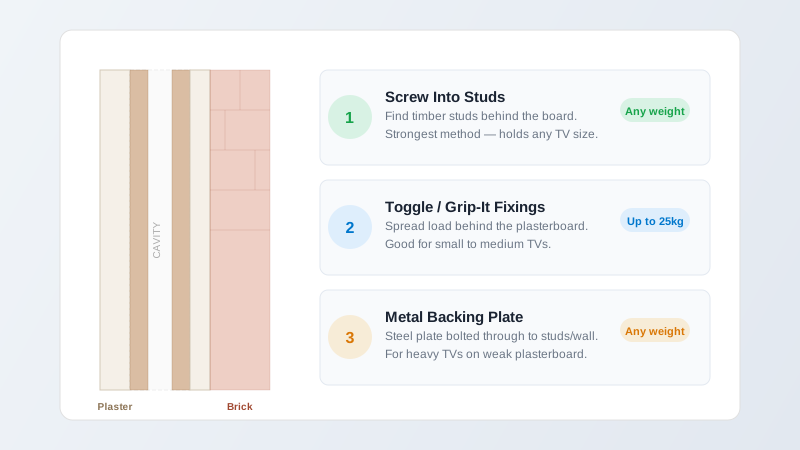
Fix Into the Studs
100 kg+This is the gold standard for mounting a TV on plasterboard. Timber studs are typically 38 mm x 89 mm (or larger), and a coach bolt or heavy-duty wood screw driven into a stud will hold serious weight — far more than any TV you'd put on a wall.
The challenge is that studs are spaced at 400 mm or 600 mm centres, and your bracket mounting holes might not line up with them. If you can hit at least two studs with the bracket, you're in excellent shape. If you can only hit one, you might fix that side into the stud and use heavy-duty plasterboard fixings on the other side.
Use an electronic stud finder to locate the studs, then confirm with a small pilot hole before committing. Knocking and listening for the change from hollow to solid works too, but a stud finder is more precise.
Grip-It and Toggle Fixings
20-25 kgFor lighter TVs — generally up to about 20–25 kg, which covers most screens up to 50 inches — specialist plasterboard fixings can work well without needing to find studs at all.
Grip-It fixings are popular and effective. They grip the back face of the plasterboard with a wide wing that spreads the load. Each Grip-It can hold around 20 kg in 12.5 mm plasterboard, and you'll typically use four to six per bracket.
Spring toggle bolts (also called gravity toggles) work on a similar principle — a metal toggle passes through the board and opens behind it, creating a large bearing surface. These are strong and reliable in plasterboard that's in good condition.
What you should never use: standard plastic rawl plugs. They rely on expansion pressure against the hole wall, and plasterboard is too soft and thin to provide that grip. They'll hold for a while and then slowly work loose.
Backing Plate for Heavy TVs
100 kg+For heavier TVs — 55 inches and above, typically 20–35 kg — the safest approach on a stud partition wall is to install a reinforcing plate behind the plasterboard. This is usually a piece of 18 mm plywood or a metal spreader plate that spans between two or more studs.
The plywood is cut to size, fixed firmly to the studs behind the board, and the bracket is then bolted through the plasterboard and into the plywood. The load is spread across a wide area and transferred to the structural timber. This method will comfortably hold any domestic TV, including 75-inch and 85-inch screens on full-motion brackets.
On dot-and-dab walls, you can sometimes remove a section of plasterboard, fix a backing plate to the masonry behind, then patch and plaster over it. The bracket then fixes through into solid material. It's more work, but it's bomb-proof.
Weight Limits — What's Safe?
Here's a practical summary of what each method can handle:
| Method | Weight Limit | Suitable For |
|---|---|---|
| Direct to studs | 100 kg+ | Any domestic TV |
| Grip-It / toggle fixings | 20–25 kg | TVs up to ~50" on fixed or tilting bracket |
| Backing plate to studs | 100 kg+ | Any TV, including full-motion brackets |
| Through to masonry | Varies (very strong) | Any TV on dot-and-dab walls |
Keep in mind that the bracket adds weight too. A full-motion bracket for a 65-inch TV can weigh 8–12 kg on its own, and it also creates leverage forces when the arm is extended — so the fixings need to handle more than just the static weight.
When to Call a Professional
If your TV is 55 inches or larger, if you can't locate any studs, or if you want cables chased into the wall for a clean finish, it's worth getting a professional to handle the job. Assessing the wall construction, choosing the right fixings and ensuring everything is level and secure is what we do every day.
Heavy TVs on full-motion brackets create significant forces on the wall fixings, especially when the arm is fully extended. Getting this wrong doesn't just risk the TV — it can tear a section of plasterboard off the wall. Roger has been mounting TVs on every wall type imaginable for over 30 years, including plenty of challenging plasterboard situations in Essex new-builds.
Need a TV Mounted on Plasterboard?
Call Roger on 07860 645446 for a free quote. We'll assess your wall and use the right method for a secure, lasting installation.
Get a Free Quote