What TV Bracket Do I Need?

Fixed, tilt or full-motion — choosing the right bracket for your TV and room

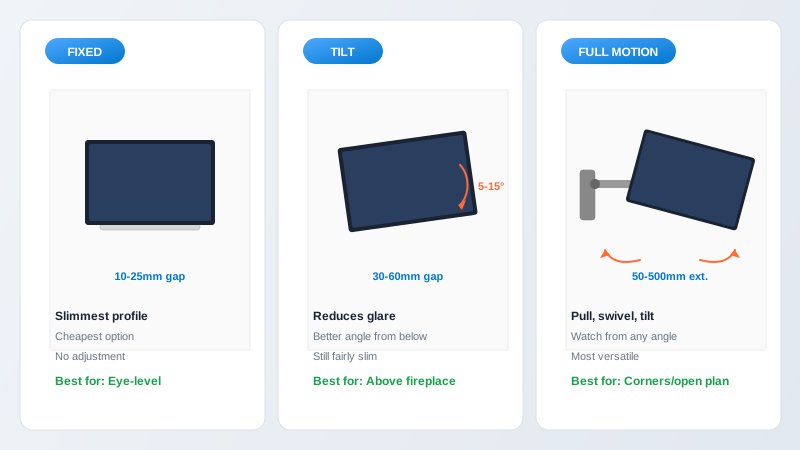
Comparison of three TV bracket types — fixed, tilt and full motion

Choosing the wrong TV bracket is one of the most common mistakes we see. Someone buys a fixed bracket, mounts their TV above the fireplace, then realises they can't tilt it down and the viewing angle is terrible. Or they buy a full-motion arm for a TV that sits perfectly flat on a straight wall — paying three times the price for movement they'll never use.

There are three types of TV bracket, and each one suits a different situation. Here's a straightforward guide based on what actually works, from over 30 years of mounting TVs across Colchester and Essex.

Quick Recommendation

If you're unsure which bracket to choose, go with a tilt bracket. It covers most situations, sits almost as slim as a fixed bracket, and costs very little more. You might not need the tilt adjustment now, but you'll appreciate having the option if you ever rearrange the room or swap to a larger TV.

The Three Bracket Types

Fixed Bracket

Slimmest Profile

A fixed bracket holds the TV flat against the wall with no movement at all. It's the simplest, cheapest and slimmest type, giving a clean, flush appearance.

Fixed brackets are the right choice when the TV is at seated eye level and you're viewing from directly in front. If you've positioned the screen at the correct height and your sofa faces the wall square-on, there's nothing to adjust. The TV looks like it's part of the wall.

The downside is obvious: no adjustment whatsoever. You can't tilt the screen down if it's mounted high. You can't swivel it towards another seating area. And accessing the cables behind the TV means lifting the whole set off the bracket. For a standard living room setup at the right height, though, fixed brackets are hard to beat.

Wall Gap 10–25mm
Movement None
Price Range Lowest
Best For Eye-level, straight-on viewing

Full-Motion Bracket

Maximum Flexibility

Full-motion brackets use an articulated arm that lets you pull the TV away from the wall, swivel it left and right, and tilt it up or down. The arm folds flat when not in use but can extend anywhere from 50mm to 500mm depending on the model.

These are ideal for corner mounting, open-plan rooms where you watch from different seating areas, or kitchens where you want to angle the screen towards the worktop or the table depending on the situation. They're also useful if you need regular access to the ports on the back of the TV.

The trade-off is price, profile and weight. Full-motion brackets cost two to four times more than fixed ones. The arm mechanism means the TV sits further from the wall when folded flat — typically 50 to 80mm. And the leverage from a fully extended arm puts significant stress on the wall fixings, so the wall itself needs to be solid enough to handle it. On plasterboard, that means fixing into studs or installing a reinforced mounting plate.

Wall Gap 50–80mm (folded)
Movement Tilt, swivel, extend up to 500mm
Price Range Mid–High
Best For Corners, open-plan, kitchens

VESA Patterns Explained

Every flat-screen TV has a standard hole pattern on the back for mounting brackets, called a VESA pattern (named after the Video Electronics Standards Association). The pattern is described by two numbers — the horizontal and vertical distances between the holes in millimetres.

VESA Pattern Typical Screen Size Common TVs
100x100 Up to 32" Small TVs and monitors
200x200 32–50" Medium TVs
300x300 / 400x400 50–70" Large TVs
600x400 70"+ Extra-large TVs

To find yours, measure the distance between the mounting holes on the back of your TV, or check the spec sheet in the manual. Most brackets sold today are universal and cover a range of VESA patterns — a typical bracket might support anything from 200x200 up to 600x400 using adjustable mounting plates.

Weight Ratings

Every bracket has a maximum weight rating. This needs to exceed the weight of your TV — and we recommend adding a 20% safety margin on top of that. A 55-inch TV typically weighs 15–20kg. A 75-inch can be 30kg or more. If your TV weighs 25kg, look for a bracket rated to at least 30kg.

Weight ratings matter more with full-motion brackets because the arm creates leverage. A TV that feels perfectly secure flat against the wall can put enormous strain on the fixings when extended 400mm out on an arm. Buy a bracket rated well above your TV's weight and make sure the wall fixings are appropriate for the wall type.

Which Bracket for Which Situation

TV at eye level, sofa directly in front Fixed bracket Cheapest, slimmest, cleanest look.
TV above a fireplace or mounted high Tilt bracket Angles the screen down to your seating position.
Corner mounting or open-plan room Full-motion bracket Pull out and swivel to face different areas.
Kitchen or bedroom with multiple viewing spots Full-motion bracket Maximum flexibility for changing positions.
Not sure Tilt bracket Covers most situations and costs very little more than fixed.

Need help choosing the right bracket for your TV and wall? Roger has been mounting TVs across Essex for over 30 years and can advise on the best setup for your room.

Call 07860 645446 for a free, no-obligation chat.

Get a Free Quote

Frequently Asked Questions

What VESA pattern is my TV?
Check the back of your TV for four threaded holes arranged in a rectangle or square. Measure the horizontal distance between the holes in millimetres, then the vertical distance. Those two numbers are your VESA pattern — for example, 200mm across and 200mm down gives you VESA 200x200. You can also find it in your TV's manual or spec sheet, usually listed under 'wall mount' or 'VESA compatibility'.
Can I use a full-motion bracket on plasterboard?
Yes, but it needs proper support. Plasterboard alone won't hold the combined weight of a TV and a fully extended arm. The bracket must be fixed into the timber studs behind the board, or a mounting plate needs to be installed to spread the load across multiple studs. For heavier TVs (40kg+), we sometimes mount a treated timber baton across two or three studs first, then fix the bracket to that. Never rely on plasterboard fixings alone for a full-motion bracket.
What's the best bracket for above a fireplace?
A tilting bracket is the best choice for above a fireplace. The extra height means you're looking up at the screen, and a tilt bracket angled 5–15 degrees downward directs the picture towards your seated position. This reduces neck strain and cuts glare from ceiling lights. Full-motion brackets also work if you need to angle the TV towards a seating area that isn't directly in front of the fireplace.
Do I need a special bracket for a large TV (65"+)?
Not necessarily special, but you do need one rated for the size and weight. A 65-inch TV typically weighs 20–30kg and uses a VESA 300x300 or 400x400 pattern. Most brackets sold as 'universal' cover VESA patterns up to 600x400 and weight ratings up to 40–50kg, which handles the majority of 65 to 75-inch TVs. Always check the bracket's maximum weight and VESA specs match your TV — don't just go by screen size alone.

Get in Touch Today

We provide TV wall mounting and home entertainment services within 30 miles of Colchester, including Epping, Loughton, Woodford, Buckhurst Hill, Chingford, Romford, Upminster, Hornchurch, Brentwood, Shenfield and Billericay.

Advanced Aerials (AV) Ltd has been vetted and approved by TrustATrader.

Call Now WhatsApp